
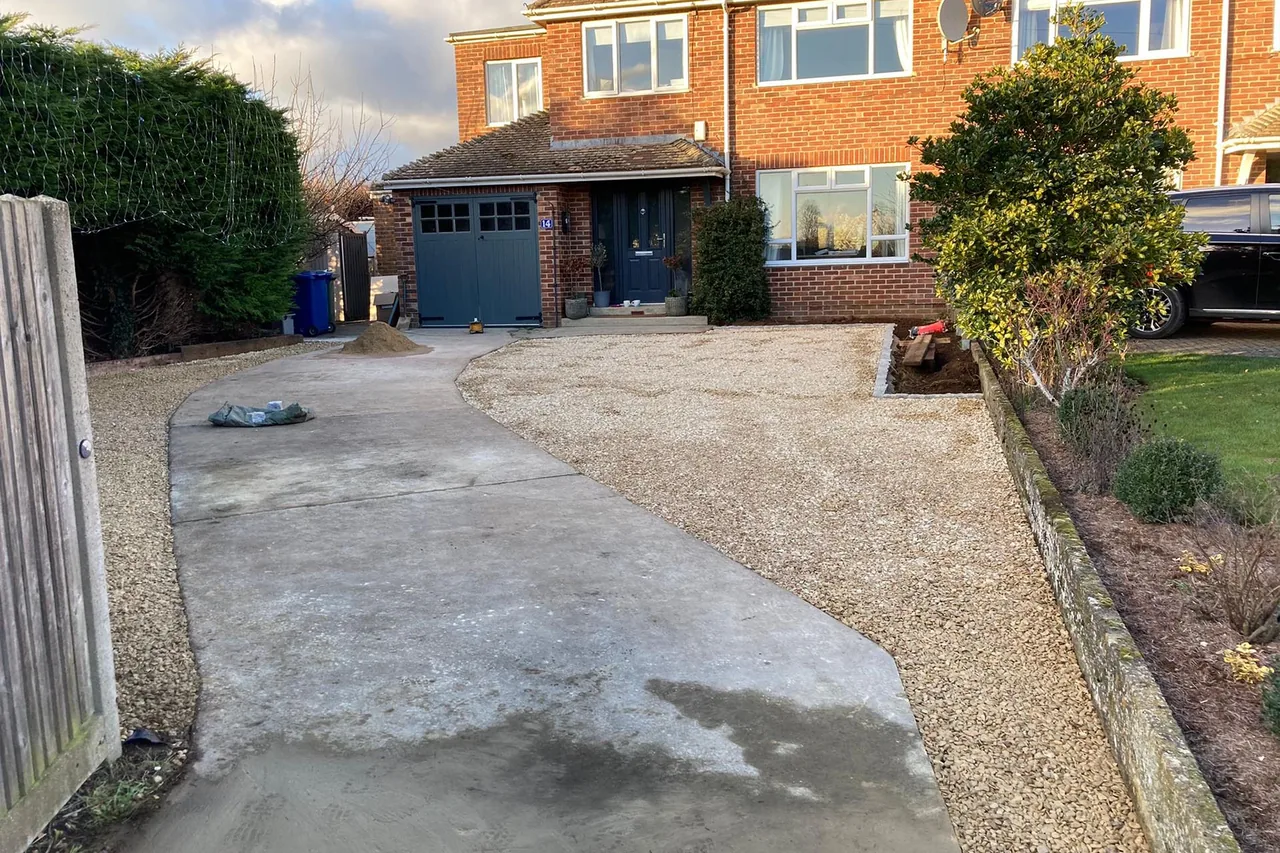
Gravel vs concrete driveway: which fits a Northshore lot?
Gravel usually costs less up front, and concrete lasts longer. HomeGuide prices a 100 by 10 foot gravel driveway at about $4,000 to $10,000. At HomeGuide’s concrete rates, the same drive works out to $6,000 to $15,000. On the Northshore, the base and the drainage under either one decide how long it holds up.
We build both. See our gravel and limestone driveways for the rock build and our concrete driveways for the poured one. The prices in this post come from published national guides, and we quote by the job after a site visit.
Which costs less to build, gravel or concrete?
Gravel usually wins the first bill, though the published ranges overlap. The table uses HomeGuide’s national cost guides unless it names Angi.
| Gravel driveway | Concrete driveway | |
|---|---|---|
| Installed price per square foot | $4 to $10 | $6 to $15, or $6 to $10 for standard gray |
| Same 100 by 10 foot drive | About $4,000 to $10,000 | $6,000 to $15,000 at those rates |
| How long it lasts | 10 to 20 years if well maintained (Angi) | 30 to 40 years with proper maintenance |
| Thickness | At least 5 to 6 inches, in layers | At least 4 inches for cars, 5 to 6 for heavier vehicles |
| Before you drive on it | No cure to wait out | At least 7 days |
On that same drive, the 2 ranges overlap from $6,000 to $10,000. So a gravel drive at the high end can cost as much as concrete at the low end. Angi puts most gravel driveway projects at $500 to $3,500, with an average of $1,800. Guides differ, so treat any national figure as a starting point.
Extras move both numbers. HomeGuide’s gravel guide puts grading at $1 to $3 per square foot. Its concrete guide adds $2 to $6 per square foot to tear out an old driveway. Steel reinforcement adds another $1 to $3 per square foot.
How long does each driveway last?
A quality concrete driveway should last 30 to 40 years with proper maintenance, HomeGuide says. Angi gives a well maintained gravel driveway 10 to 20 years before a full replacement. That rebuild pulls the old gravel and preps the base for new stone. Angi prices it at $1,500 to $6,000.
Gravel also needs yearly work. Angi says to budget $100 to $400 a year, which comes to $2,000 to $8,000 over 20 years. That budget covers regrading and fresh gravel for potholes and ruts. A concrete driveway has no loose rock to regrade, though its long life still assumes proper maintenance.
How is each driveway built?
A gravel driveway goes down in layers. HomeGuide’s minimum is 5 to 6 inches of rock in all. In most installations, the bottom 3 to 4 inches are crusher run or crushed stone. The top 2 to 3 inches are surface rock.
FHWA’s gravel roads guide says good surface gravel mixes stone, sand and fines. The guide also calls for a crown that rises about 1/2 inch per foot toward the middle. That slope sheds rain to the sides. We cut the ground to grade and shape the crown as part of our grading and dirt work.
A concrete driveway is a slab poured over a compacted base. HomeGuide says it should be at least 4 inches thick for standard vehicles. Pros recommend 5 to 6 inches for heavier ones, such as an RV. The edges should be 6 to 8 inches thick.
Gravel has no cure to wait out. New concrete needs at least 7 days before you drive on it, and full cure takes 28 to 30 days. Our post on how a concrete driveway compares with a slab or patio covers steel and curing.
Why does the ground under the drive matter so much here?
Rain is the hard part for any driveway on the Northshore. Covington averages 62.51 inches of rain a year, going by NOAA’s 1991 to 2020 normals. The Abita soils on the terraces around Covington drain somewhat poorly, USDA says, and water moves through them slowly. From December through April, their water table rises to within 1 to 3 feet of the surface.
On ground like that, gravel sinks into soft spots and the drive breaks into potholes and ruts. A slab poured on a poor base can crack and settle. The answer for either drive is a compacted stone base and a way for water to leave.
That base is stone you buy. A 2011 USGS report found that Louisiana imports almost all of its aggregate. The bulk of it comes in by barge from other states or by freighter from Mexico.
Crushed limestone sold on the Northshore includes 610 and 57. The 610 grade runs 1 inch and down and carries fines, so it packs tight. The 57 grade is a 3/4 inch stone sold for driveways and base layers.
Recycled crushed concrete is another choice, as a rock drive or as the base under either surface. We produce it and haul it on our own dump trucks. FHWA puts its bearing strength on par with crushed limestone.
HomeGuide’s national prices put crushed concrete at $11 to $53 a ton and crushed limestone at $30 to $38. Crushed concrete’s range starts below limestone’s and ends above it, so compare quotes. Our post on crushed concrete vs limestone covers the rock choice in depth.
What rules apply to either driveway in St. Tammany Parish?
The parish rules below apply in unincorporated St. Tammany Parish, and the fill rules cover only certain lots. Inside a city such as Covington, Mandeville or Slidell, ask the city what applies. Wherever you are, confirm your own lot with the parish or the city before work starts.
A drive that must climb out of a low spot runs into fill limits. In a critical drainage area, driveway fill stays within 6 inches of natural ground. Foundation fill for the house, carport or garage is the exception. Critical drainage areas include land FEMA maps as Flood Hazard Area A.
Residential lots under 90 feet wide get a cap when the subdivision has no drainage plan approved by parish engineering. There, driveway fill averages 6 inches at most. If your lot needs a drainage plan or a survey, a licensed engineer or surveyor prepares it. We build the drive to that plan and work through the paperwork with you.
Gravel or concrete, a drive that crosses a roadside ditch needs a culvert. In the parish right of way, the parish requires a culvert type approved by LADOTD, the state transportation department. The pipe must be at least 15 inches and sized for a 10 year storm. We set it before the base goes down, as part of our driveway culvert installation.
On a state highway, LADOTD regulates driveway connections. Its access connection permit comes before any construction. The residential permit covers 1 to 5 homes on a single connection. Call 811 before any digging so Louisiana 811 can notify utilities with lines underground.
Which driveway fits your lot?
The choice usually comes down to the first bill against the years of upkeep. Your lot and your vehicles settle the rest.
- Pick gravel when the first bill matters most, such as on a long drive. Plan on Angi’s $100 to $400 a year for upkeep.
- Pick concrete for the 30 to 40 year life, if cars can stay off it at least 7 days. Go 5 to 6 inches if an RV will park on it.
- Pick crushed concrete for a recycled rock drive. It also works as the base under either surface.
- Plan on 2 things either way: a compacted base, and a culvert where the entrance crosses a ditch.
FAQ
Is gravel or concrete cheaper for a driveway?
Gravel usually costs less up front, though the published ranges overlap. HomeGuide prices a 100 by 10 foot gravel driveway at about $4,000 to $10,000. At HomeGuide’s concrete rates, the same drive works out to $6,000 to $15,000. Gravel adds yearly upkeep, and we quote either drive by the job after a site visit.
How long does a concrete driveway last compared with gravel?
A quality concrete driveway should last 30 to 40 years with proper maintenance, HomeGuide says. Angi gives a well maintained gravel driveway 10 to 20 years before a full replacement. Angi prices that rebuild at $1,500 to $6,000. On wet Northshore ground, the base under either drive has a big say in how long it lasts.
How thick should a concrete driveway be compared with gravel?
A concrete driveway should be at least 4 inches thick for standard vehicles, HomeGuide says. Pros recommend 5 to 6 inches for heavier ones, such as an RV. The edges should be 6 to 8 inches thick. A gravel driveway needs at least 5 to 6 inches of rock, installed in layers.
How much upkeep does a gravel driveway need?
Angi says to budget $100 to $400 a year for gravel driveway upkeep. Over 20 years, that adds up to $2,000 to $8,000. The money goes to regrading and fresh gravel for potholes and ruts. Keep the crown FHWA’s gravel roads guide recommends, about 1/2 inch per foot, so rain runs off.
Does St. Tammany Parish limit fill under a new driveway?
Yes, on some lots in unincorporated St. Tammany Parish, so confirm yours with the parish. In a critical drainage area, driveway fill stays within 6 inches of natural ground. Foundation fill for the house, carport or garage is the exception. On residential lots under 90 feet wide with no approved subdivision drainage plan, driveway fill averages 6 inches at most.
What do we need to quote your driveway?
Give us the size of the drive and what will park on it. Mention any roadside ditch at the entrance. We look at the ground on a site visit and quote by the job.
W2 Commercial Construction is a Louisiana State Licensed Contractor, LA State Lic# 78829, and fully insured. Our work on Northshore ground goes back more than 20 years. For a free estimate on either drive, reach us through our gravel driveway installation page.