
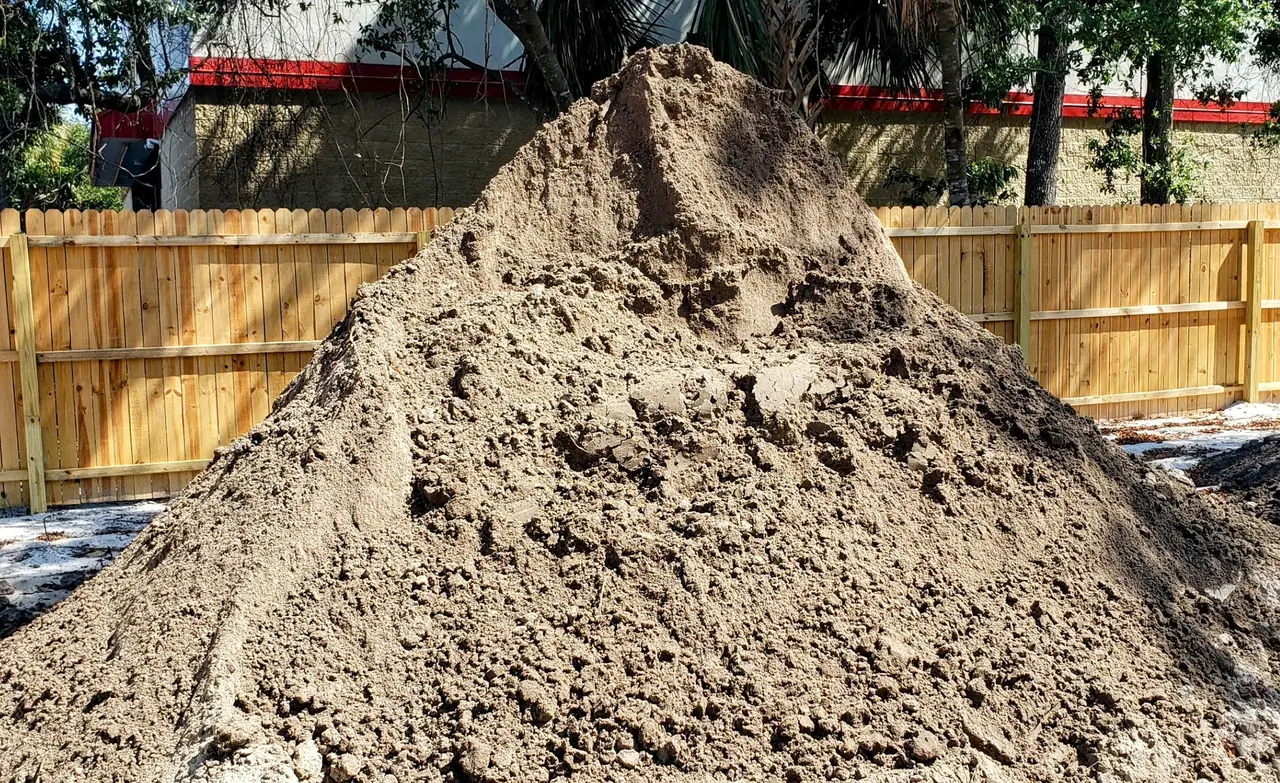
Fill dirt vs topsoil vs sand: which one does your Louisiana project need?
Topsoil is the dark, organic top layer of the ground, and it belongs on lawns and gardens. Fill dirt is inorganic subsoil that raises and levels ground under pads and drives. Sand drains, and the state residential code lets it run deepest under a slab. Unless deeper fill is approved, clean sand or gravel can go 24 inches deep, and earth only 8 inches.
On a new home site, the slab sits on compacted fill and the lawn around it grows in topsoil. We sell fill dirt by the truckload, and our own dump trucks handle the fill dirt delivery.
What is the difference between fill dirt, topsoil and sand?
Topsoil is the top layer of soil, found within the first 5 to 12 inches of ground. It is rich in minerals and nutrients. HomeGuide’s national cost guide notes its dark color comes from high organic matter. It is the soil for lawns and gardens.
Standard fill dirt is inorganic subsoil, made of broken down rock, clay and sand. HomeGuide calls it a place filler that gives construction projects stability. Certified clean fill is free of organic matter and debris. Structural fill is screened, highly compactable dirt: small stones, clay and enough sand to drain.
Sand is the part of that mix that drains. On its own, clean sand also gets more depth under a slab than any dirt in the state code.
| Question | Topsoil | Fill dirt | Sand |
|---|---|---|---|
| What it is | Dark top layer, high in organic matter | Inorganic subsoil of broken down rock, clay and sand | Granular material that drains |
| Where it belongs | Lawns and gardens | Raising and leveling ground under pads and drives | Fill under a slab, and mixes that need to drain |
| Under a slab (2021 IRC) | Stripped off first | Up to 8 inches of earth unless deeper fill is approved | Up to 24 inches of clean sand unless deeper fill is approved |
Which one goes under a slab or house pad?
Compacted fill dirt or clean sand goes under a slab, and the topsoil comes off first. Louisiana’s residential code is the 2021 International Residential Code (IRC). Section R506.2.1 keeps vegetation and foreign material out of the fill under a slab.
The same section sets the 24 and 8 inch depth limits, unless deeper fill is approved. So a deep pad gets built to approved plans. Topsoil is the organic layer, so it stays out of that fill. On a pad job, our dump trucks haul compactable clay in and haul the topsoil off.
St. Tammany’s own Coastal Resilience Land Use Study describes 2 general methods for building a home in the floodplain. One is a slab home on compacted fill. The other is an open foundation on piers or pilings. We build the house pad and can pour the slab, and the builder handles any pier or piling foundation.
Narrow lots carry a fill cap in unincorporated St. Tammany. The cap applies in zones A, AE, AO, AH, X and D, on residential lots narrower than 90 feet. There, the most fill allowed to raise a home is 24 inches. Anything higher calls for a raised foundation such as piers or pilings, which is the builder’s work.
Our guide to house pad permits in St. Tammany covers floor heights and the rest of the fill rules. Confirm the rules for your own lot with the parish. Covington, Mandeville, Slidell and the other incorporated towns each set their own rules.
Which one fixes a low or soggy yard?
Topsoil grows grass, but a few inches of it will not stop water from standing. The trouble sits below it. Take the Abita soils on St. Tammany’s terraces, which USDA rates somewhat poorly drained and slowly permeable. Their seasonal high water table rises to within 1 to 3 feet of the surface each December through April.
New topsoil on top does not change how the ground under it drains. What moves standing water is grade. Grading and dirt work shapes the yard so water runs off toward a ditch or swale.
Where grade alone cannot carry it, a French drain can move it underground to an outlet. Topsoil then goes on last, as the layer the new grass grows in.
Raising the whole yard with fill runs into parish rules. In unincorporated St. Tammany, net fill means fill that raises ground above its natural level. The code strictly prohibits it on any lot 90 feet wide or less, and in any critical drainage area.
FEMA A zones count as critical drainage areas. The exceptions are an approved development plan or the engineering department’s written consent. Check your lot with the parish before any fill comes in.
What goes under a driveway?
Fill dirt brings a drive up to grade, and base rock on top carries the traffic. Topsoil stays out of both layers, since it is the organic one. For the rock, our guide to crushed concrete vs limestone compares 2 base rocks. The build itself, from the dirt up, is on our gravel driveways page.
On some lots in unincorporated St. Tammany, the code caps the fill under a drive. This cap covers residential lots narrower than 90 feet in subdivisions without a drainage plan approved by parish engineering. In zones A, AE, B, C and X, driveway fill there averages 6 inches above natural ground at most. Fill that ties the drive into the foundation of the house, carport or garage is the exception.
That leaves little room to build a drive up with dirt on those lots. Ask the parish about your lot before you plan a raised drive.
How much comes in a dump truck load, and what does each cost?
HomeGuide’s national cost guide says a truckload typically holds 10 to 14 cubic yards of dirt. Its figure for an average commercial dump truck is 8 to 12 cubic yards. Its published national prices:
| Material | Price per cubic yard | Delivered dump truck load |
|---|---|---|
| Fill dirt | $5 to $25 | $150 to $400 |
| Topsoil | $10 to $50 | $150 to $500 for 10 to 15 yards |
| Sand | $15 to $50, delivered | $300 to $700 |
The same guide puts structural fill at $10 to $30 per cubic yard. All of these figures are national. We quote by the load or by the job after a site visit.
Every cubic yard holds 27 cubic feet. Raising a 20 by 30 foot area by 6 inches takes 300 cubic feet of fill. That comes to about 11 cubic yards, or about 1 truckload of 10 to 14 yards. HomeGuide says to add 5 to 10 percent for waste and spills, so plan on about 12 yards.
For a new lawn, HomeGuide figures a cubic yard of topsoil covers 55 square feet at 6 inches deep. It also advises keeping a loaded dump truck off a wet or damp yard. Plan a drop spot the truck can reach on firm ground.
FAQ
Is fill dirt the same as topsoil?
No, fill dirt is inorganic subsoil of broken down rock, clay and sand that packs down under pads and drives. Topsoil is the dark top layer, high in organic matter, that grows lawns and gardens. For fill under a slab, the state residential code rules out vegetation and foreign material. Organic topsoil comes off a pad site for that reason.
What goes under a house slab: fill dirt, sand or topsoil?
Compacted fill dirt or clean sand, with the topsoil stripped first. Louisiana’s residential code is the 2021 IRC, and section R506.2.1 sets the limits. Unless deeper fill is approved, compacted fill under a slab stops at 24 inches of clean sand or gravel. Earth stops at 8 inches, so deeper pads follow the approved plans.
Will topsoil fix a soggy yard?
Not on its own, since the problem sits in the ground below it. USDA rates the Abita soils on St. Tammany’s terraces somewhat poorly drained and slowly permeable. Their seasonal high water table is 1 to 3 feet below the surface from December through April. Grading that sheds water, or a drain that carries it off, is what moves it.
Can I bring in fill dirt to raise my yard in St. Tammany Parish?
It depends on the lot, because unincorporated St. Tammany restricts net fill. Net fill raises ground above its natural level, and it is strictly prohibited in any critical drainage area. FEMA A zones count, and the exceptions are an approved development plan or the engineering department’s written consent. Inside a town such as Covington or Slidell, ask the town.
How much dirt comes in a dump truck load?
Typically 10 to 14 cubic yards in HomeGuide’s national guide, with the average commercial dump truck at 8 to 12. A 20 by 30 foot area raised 6 inches takes about 11 cubic yards, or about 1 load. Add 5 to 10 percent for waste and spills. We quote by the load after a site visit.
How much do fill dirt, topsoil and sand cost?
HomeGuide’s published national ranges run $5 to $25 per cubic yard for fill dirt and $10 to $50 for topsoil. Sand runs $15 to $50 per cubic yard delivered, or $300 to $700 a truckload. Delivered loads run $150 to $400 for fill dirt and $150 to $500 for 10 to 15 yards of topsoil. W2 quotes by the load or by the job after a site visit.
How do you order fill dirt from W2?
Tell us what the dirt is for, such as a pad, a low spot or a drive. Give us the size of the area and how high it needs to come up. Mention whether the lot sits in unincorporated St. Tammany or inside a town.
Every quote comes by the load or by the job, after a site visit. W2 Commercial Construction holds LA State Lic# 78829 and is fully insured, with more than 20 years on Northshore ground. Request your free estimate from the fill dirt hauling page.