
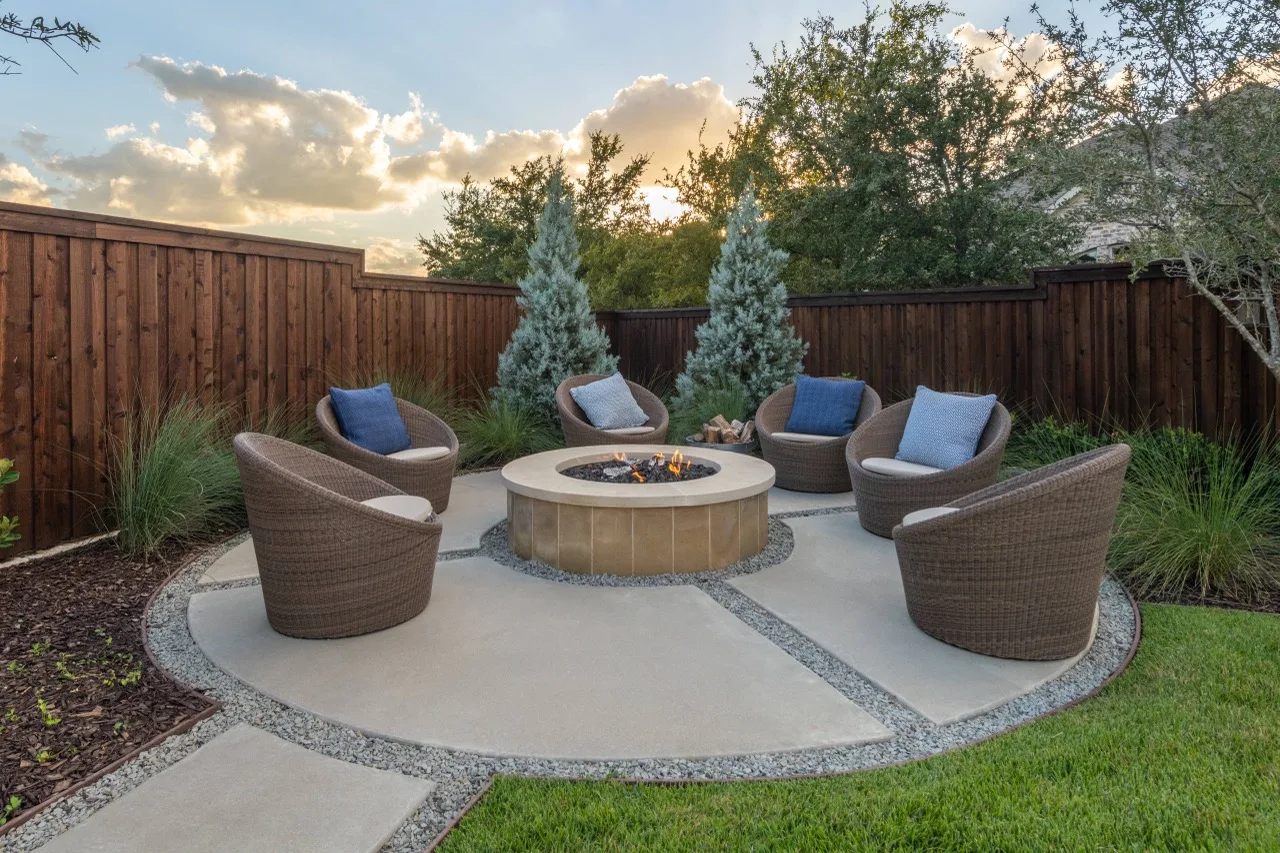
What’s the difference between a concrete driveway, slab, and patio in South Louisiana?
All three are flatwork, and the finished surface looks similar. What changes is the load each one carries, and that sets the thickness, the steel, the base, and the price. A patio carries people, so 4 inches works. A driveway carries vehicles, so it gets more base and steel, and often 5 inches. A garage or shed slab carries point loads and gets the same treatment plus thicker edges. On South Louisiana ground, the part that decides how long any of them lasts is what happens under the concrete, not on top of it.
How thick should each one be?
Four inches is the working standard for residential flatwork, and code allows as little as 3.5 inches for a slab floor. The differences show up in the details.
| Patio | Driveway | Garage / shed slab | |
|---|---|---|---|
| Typical thickness | 4 in. | 4–5 in. | 4–5 in., thickened edges |
| Reinforcement | Mesh or fiber | Mesh at 4 in., rebar at 5 in. | Rebar or mesh, per load |
| Typical strength | 2,500–3,000 psi | 3,000–3,500 psi | 3,000–3,500 psi, 4,000 with hard-trowel finish |
| Plain cost / sq ft | $5–$8 | $5–$8 | $6.50–$10.50 |
| Carries | Foot traffic, furniture | Cars, trucks | Vehicles, equipment, storage |
Going from 4 to 5 inches on a driveway adds about 20% to the cost and close to 50% more load capacity. That trade is usually worth it if trucks, trailers, or an RV will ever sit on it. Published guides also call for at least 5 inches under heavy fixed loads, like a shed or a spa, and the industry prices most residential flatwork on a 3,500 psi mix.
What goes under the slab matters more than the slab
Every failed driveway we see around the Northshore failed from below. The build order that prevents it is not complicated, and code spells most of it out. Strip the topsoil and anything organic. Bring in a base course, at least 4 inches of gravel or crushed stone, and 2 to 8 inches of crushed rock where the soil is expansive. Compact it to 95% density in lifts. On enclosed slabs, lay a vapor retarder. Then pour.
The base does two jobs on our ground. It gives the slab uniform support, which is what stops random cracking. And it works as a capillary break, so water sitting a few feet down cannot wick up into the concrete. Around here the water table sits 1 to 3 feet below the surface from December through April, which is why grading and dirt work shows up on local concrete quotes. Skip the base and the slab rides directly on soil that moves with every wet and dry cycle. We cover that failure chain in pouring concrete on Louisiana clay.
Rebar, mesh, or fiber: which one and when
Mesh suits slabs at 4 to 5 inches. Rebar takes over at 5 inches and up, typically half-inch bar on a 12-inch grid. Synthetic fibers help control early shrinkage cracking, but the industry bulletins are blunt that fibers do not replace steel and do not let you pour thinner.
Two facts worth knowing before you compare bids. First, no reinforcement prevents cracks. The National Ready Mixed Concrete Association’s own bulletin says wire mesh “will not prevent cracking.” Steel controls how wide cracks open, which is what keeps them cosmetic instead of structural. Second, the steel only works if it sits in the right place. Code requires it supported in the upper half of the slab on chairs. Mesh laid on the ground and pulled up by hand usually ends up at the bottom, where it does nothing.
How the three projects compare on cost
Plain gray runs $5 to $8 per square foot for a patio or driveway, and $6.50 to $10.50 for a general slab. The totals separate because the footages differ. A patio might be 200 square feet while a two-car driveway is 640.
A 20x20 example, at 400 square feet, from published 2026 rates:
- Patio: $3,200 to $7,200 across plain and finished work
- Driveway pad, plain: $2,000 to $3,200
- Garage or shed slab: $2,400 to $4,800
Decorative finish is the multiplier. A broom-finish patio prices around $10 to $13 per square foot in the May 2026 trade data, while the same patio stamped runs $24 to $29. Our stamped concrete guide breaks down where that money goes. If you are weighing a patio against a raised wood platform instead, that is a different build and a different budget; we build decks too, and the honest comparison depends on your yard’s drainage and elevation.
Concrete or asphalt for a Louisiana driveway?
Concrete costs more on day one and less over its life here.
| Concrete | Asphalt | |
|---|---|---|
| Installed, per sq ft | $5–$8 plain ($8–$20 with labor loaded) | $3–$6 ($7–$15 with labor loaded) |
| Lifespan | 30–40 years | 15–20 years |
| Upkeep | Occasional sealing, joint care | Sealing every 3–5 years |
| In Gulf heat | Stays rigid, runs cooler | Softens, ruts under slow heavy loads |
The climate point decides it for most people here. Industry comparisons favor asphalt in freeze country and concrete in hot climates. St. Tammany summers hold highs at or above 90 degrees for three months. That is rutting weather for asphalt and normal service for concrete.
How long before you can use it
Walk on it after 24 hours. Park a car on it after 7 days, when the slab has about 70% of its strength. Keep heavy trucks, RVs, and equipment off for 28 days.
Curing is separate from waiting, and in our heat it is the step that gets skipped. The mix needs to stay moist for at least the first 3 days, ideally 7. Concrete left to dry-cure can give up as much as half its potential strength. Summer pours here also need their control joints cut within 6 to 12 hours, before the slab decides where to crack on its own.
What about the local rules?
Two are worth knowing before any bid. In unincorporated St. Tammany Parish, development in the floodplain requires a permit, and that includes earthwork, so low lots can carry a permitting step before the forms go in. Grading rules also apply everywhere: the ground next to a house has to fall 6 inches in the first 10 feet, and paved surfaces near the foundation need to slope away at about a quarter inch per foot.
The metro side has its own layers. Kenner, for example, requires a permit for any cement work and fences, routes driveway aprons through its Public Works department, and caps front-yard paving at 40% of the yard. A crew that works these parishes prices the paperwork in rather than discovering it mid-job.
FAQ
How much does it cost to concrete your driveway? Plain gray concrete runs $5 to $8 per square foot, so a typical two-car driveway (about 640 square feet) lands between $3,200 and $5,100. Decorative finishes push it to $8 to $21 or more. National guides put whole projects at $3,200 to $13,000 depending on size and finish.
How much would a 20x20 driveway cost? A 20x20 pad is 400 square feet. At the published $5 to $8 per square foot for plain concrete, that works out to $2,000 to $3,200. With a decorative finish it runs $3,200 to $5,600. Note that 20x20 is a parking pad; a full two-car driveway is usually closer to 640 square feet.
Is a concrete driveway cheaper than asphalt? No. Asphalt installs at $3 to $6 per square foot against $5 to $8 for plain concrete. The gap narrows over the life of the surface. Concrete lasts 30 to 40 years while asphalt lasts 15 to 20 and needs sealing every 3 to 5 years. In Gulf South heat, asphalt also softens and ruts.
Is a concrete driveway a good idea? In South Louisiana, usually yes. Concrete lasts 30 to 40 years, needs little upkeep, and handles our heat better than asphalt, which softens and ruts in high temperatures. The trade is that concrete costs more up front, and any slab will crack if the base under it is done poorly.
How long before you can drive on new concrete? Stay off it for 24 hours on foot, keep cars off for 7 days, and keep heavy trucks, RVs, and equipment off for 28 days. At 7 days the slab has about 70% of its strength. Curing matters too: concrete kept moist for the first week ends up much stronger than a slab left to dry out.
Talk through your project
Whether it is a driveway, a slab for a garage or shop, or a patio, the right answer starts with your ground and your loads. W2 Commercial Construction handles concrete work and the site prep under it across the Northshore and Greater New Orleans. Ask for a free estimate and we will measure the job, check what the soil needs, and give you a written price for the build that fits.